
Beard Transplant UK: Procedure, Results & Recovery
A beard transplant is a surgical facial hair restoration procedure that moves your own hair follicles into areas where beard growth is sparse, patchy or absent. It can help improve beard density, restore a moustache, create greater facial symmetry and camouflage selected areas of scarring.
Unlike scalp hair transplantation, facial hair restoration requires particularly precise planning because beard hairs grow at different angles and directions across the cheeks, jawline, chin and moustache. Donor hair characteristics, existing facial hair, beard design and the intended density all need to be considered before transplantation.
For patients considering a beard transplant in the UK, understanding these factors is more useful than simply comparing graft numbers or advertised prices. A natural-looking result depends on how the treatment is planned and performed as well as how many follicles are transplanted.
What is a Beard Transplant?
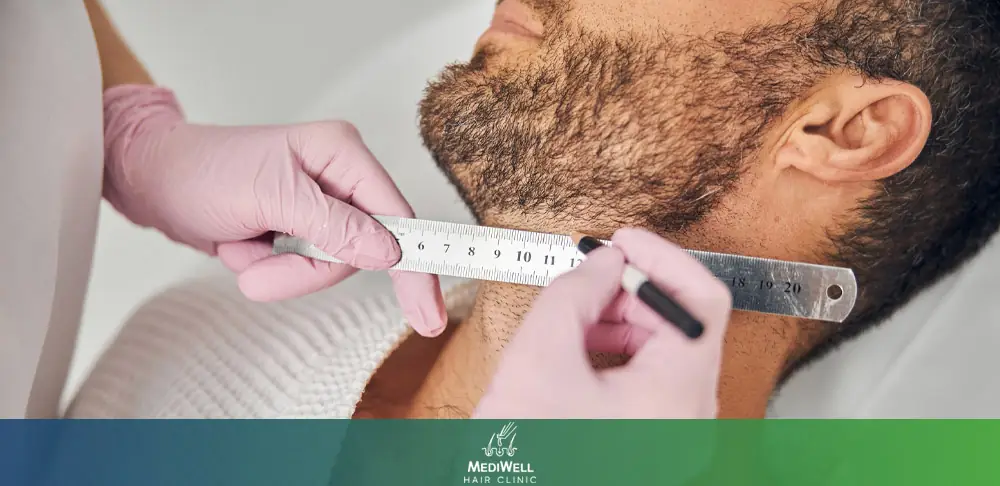
A beard transplant moves your own hair follicles from a suitable donor area into areas of sparse or absent facial hair.
The donor follicles are commonly taken from the scalp, particularly the back or sides, although selected cases may involve suitable facial hair as a donor source. Individual follicular units are extracted and then implanted into carefully planned recipient areas.
A beard transplant may be considered for:
- Patchy beard growth
- Sparse cheek coverage
- An incomplete moustache
- Uneven facial hair
- Areas with little or no beard growth
- Selected facial scars
- Hair loss following trauma or surgery
- Naturally low facial hair density
The term “beard implants” is also used online to describe this treatment. However, modern beard transplantation normally uses the patient’s own hair follicles rather than artificial hair.
How is a Beard Transplant Different From a Scalp Hair Transplant?
The basic transplantation principle is similar, but the aesthetic requirements are different.
Scalp hair usually emerges from the skin at a different angle from facial hair. Beard hairs can also change direction between the cheek, jawline, chin and moustache.
This makes precise implantation particularly important.
A beard transplant must account for:
- Hair angle
- Hair direction
- Graft selection
- Density
- Facial proportions
- Existing beard growth
- The planned beard outline
ISHRS guidance highlights the importance of matching implantation direction and angle to the natural characteristics of each facial area.
Who is a Beard Transplant Suitable For?
A beard transplant may be suitable for men who have persistently sparse, patchy or uneven facial hair and have sufficient donor follicles for transplantation.
Potential candidates may include people with:
- Naturally sparse beard growth
- Patchy cheeks
- An incomplete moustache
- Uneven beard density
- Poor connection between beard and moustache
- Areas affected by trauma
- Selected acne or surgical scars
- Congenitally low facial hair density
Suitability cannot be determined from beard density alone.
A medical assessment should consider donor hair availability, hair characteristics, recipient skin condition, existing facial hair and the patient’s expectations.
ISHRS identifies low beard density, congenital gaps and certain forms of scarring as reasons patients may seek facial hair transplantation. It also stresses the importance of assessing the recipient skin before treatment.
Can Younger Men Have a Beard Transplant?
Age alone does not determine suitability.
However, facial hair can continue developing during early adulthood. If natural beard growth has not stabilised, predicting the long-term pattern can be more difficult.
For this reason, treatment planning should consider the existing beard pattern, donor supply, facial development and long-term expectations rather than relying on a single age threshold.
How Does a Beard Transplant Work?
A beard transplant generally involves four main stages:
- Facial hair and donor assessment
- Beard design and treatment planning
- Donor follicle extraction
- Recipient-site preparation and graft implantation
The exact process varies according to the patient’s anatomy, donor supply, treatment area and surgical plan.
1. Facial Hair Assessment
Before treatment, the surgeon should assess:
- Existing beard density
- Moustache growth
- Cheek coverage
- Jawline
- Chin
- Donor density
- Hair thickness
- Hair colour and texture
- Skin condition
- Desired beard shape
The purpose is to determine how much restoration is realistic without unnecessarily using donor follicles.
2. Beard Design
The desired beard shape is planned before transplantation.
Beard design is one of the most important aspects of facial hair restoration because the outline can affect the overall appearance of the face.
The surgeon may assess:
- Cheek line
- Jawline
- Chin
- Moustache
- Sideburns
- Neck transition
- Connections between facial hair zones
The design should also account for how the patient intends to wear the beard in the future.
ISHRS notes that beard design should consider facial anatomy, implantation zones and the patient’s expectations. It also highlights that beard styles can change over time, making long-term design an important consideration.
3. Donor Follicle Extraction
With FUE, individual follicular units are extracted from the donor area using a small punch.
The follicles are then prepared for transplantation.
Donor management is important because extracted follicles cannot simply be replaced. Excessive harvesting may reduce donor density and limit future hair restoration options.
ISHRS describes the safe scalp donor area as the main donor source for many beard transplant procedures, while also noting that selected facial hair can be used in some circumstances.
4. Graft Implantation
The prepared follicles are placed into carefully planned recipient sites.
The surgeon must control:
- Implantation angle
- Growth direction
- Depth
- Spacing
- Density
- Graft position
The objective is not simply to add as many follicles as possible.
The objective is to place the appropriate follicles in the appropriate facial zones.
Where Does the Hair for a Beard Transplant Come From?
The scalp is the most common donor source for beard transplantation.
The back and sides of the scalp can provide a useful supply of follicles when the donor area is suitable. ISHRS identifies the occipital and lateral scalp as the main donor areas in facial hair transplantation.
In selected cases, hair from beneath the jawline may also be considered as a donor source.
Facial donor hair can have characteristics that are closer to beard hair, but the number of available follicles is limited.
Donor selection therefore depends on:
- Hair thickness
- Hair colour
- Curl or wave pattern
- Donor density
- Available follicular units
- Recipient requirements
- Future hair restoration needs
A suitable donor area is not simply the area with the highest number of hairs. It must also be harvested in a way that preserves the appearance and long-term usefulness of the donor area.
How is a Natural-Looking Beard Designed?
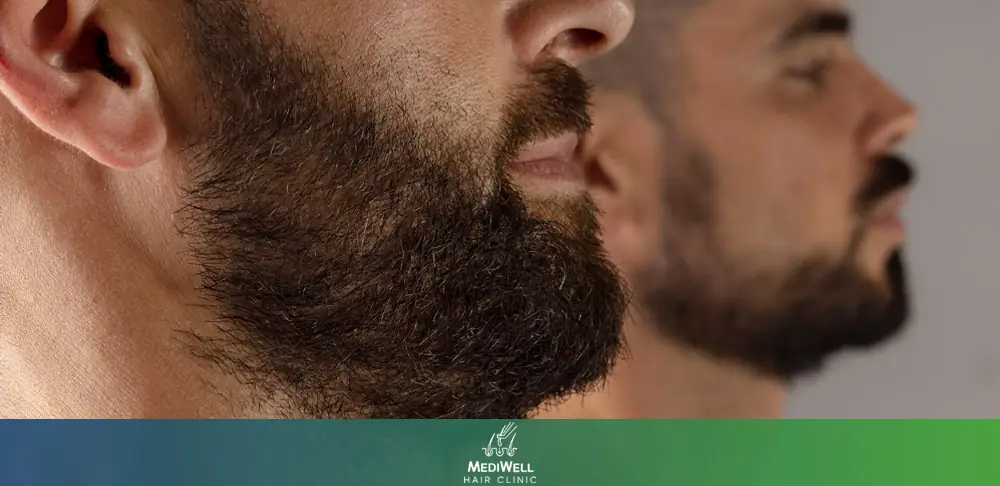
A natural-looking beard depends on the angle, direction and placement of each graft, not only the number of grafts used.
The facial hair area can be divided into several zones, including:
- Moustache
- Chin
- Cheeks
- Jawline
- Sideburns
Each zone can have a different growth direction and density.
ISHRS specifically describes different implantation zones across the moustache, chin, cheek and jaw areas and recommends matching implantation direction and angle to the existing facial hair.
The Five Factors Behind a Natural-Looking Beard
| Factor | Why it matters |
|---|---|
| Angle | Beard hairs normally emerge at a relatively low angle to the skin |
| Direction | Hair direction changes between facial zones |
| Graft selection | Single-hair grafts can help create softer borders |
| Density | Density should be appropriate for the area and existing hair |
| Design | The beard should complement the patient's facial proportions |
The goal is not necessarily maximum density.
The goal is appropriate density in the correct anatomical position.
FUE vs DHI for a Beard Transplant
FUE and DHI are often described as competing hair transplant techniques, but they refer to different parts of the transplantation process.
| Feature | FUE | DHI |
|---|---|---|
| Follicle extraction | Individual follicular units | Usually individual follicular units |
| Donor harvesting | FUE extraction | Usually FUE extraction |
| Implantation | Recipient sites followed by graft placement | Implanter-assisted placement |
| Implantation control | Depends on recipient-site preparation and technique | Implanter can assist placement |
| Facial hair use | Suitable | Suitable in selected cases |
| Main consideration | Donor extraction and recipient-site planning | Graft placement and handling |
FUE primarily describes how the follicular units are harvested.
DHI generally refers to an implantation approach using an implanter device.
Neither technique should automatically be considered superior for every patient. The appropriate approach depends on donor characteristics, recipient areas, graft requirements and the surgeon’s treatment plan.
How Many Grafts Are Needed for a Beard Transplant?
There is no single graft number that defines a full or successful beard transplant.
The required number depends on the size of the treatment area, existing beard density, desired appearance, hair characteristics, implantation design and available donor follicles.
For example, a patient filling a small cheek gap may require substantially fewer grafts than someone seeking extensive beard reconstruction.
| Treatment objective | Graft requirement |
|---|---|
| Small isolated patch | Usually a relatively small number of grafts |
| Moustache or sideburn enhancement | Depends on the area and existing density |
| Patchy beard correction | Varies according to the size and number of gaps |
| Partial beard restoration | Requires assessment of multiple facial zones |
| Extensive restoration | May require a larger donor allocation |
| Full beard reconstruction | Requires careful donor and long-term planning |
These categories are deliberately not assigned fixed graft numbers because individual requirements vary significantly.
ISHRS states that graft quantity depends on factors including patient expectations, facial size, implantation design, treatment area, desired follicular-unit density, hair thickness, existing recipient hair and the amount of donor hair available.
Using more grafts does not automatically produce a better result.
A carefully planned treatment may prioritise the most visible facial zones while preserving donor follicles for future needs.
What Happens During a Beard Transplant?
A beard transplant is generally performed using local anaesthesia.
The procedure may include:
- Medical assessment and final treatment planning
- Beard design and recipient-area marking
- Donor-area preparation
- Local anaesthesia
- Individual follicle extraction
- Graft preparation
- Recipient-site preparation
- Graft implantation
- Post-operative assessment
- Aftercare instructions
The duration depends on the number of grafts and the complexity of the treatment.
Mediwell Hair Clinic currently describes its beard transplant package as accommodating up to 2,600 grafts, with an estimated procedure time of approximately 4–6 hours. Individual treatment plans and procedure times can vary.
Beard Transplant Recovery Timeline
Recovery occurs gradually.
The first days focus on protecting the recipient area and allowing the skin to heal. During the following weeks, transplanted hairs may shed before new growth develops.
| Period | What may happen |
|---|---|
| Days 1–7 | Redness, mild swelling and small crusts may occur |
| Weeks 2–4 | Transplanted hairs may begin shedding |
| Months 3–4 | Early new growth may become visible |
| Months 5–6 | Density gradually becomes more noticeable |
| Months 6–9 | Growth and hair maturation continue |
| Months 9–12 | Density and texture continue developing |
| Months 10–14 | The result can approach its mature appearance |
ISHRS states that facial hair transplant results are generally assessed over a longer period, with shedding followed by regrowth around three to four months and overall results becoming visible at approximately 10–14 months.
The NHS similarly notes that transplanted hairs commonly shed after several weeks, with new growth beginning after around four months and full scalp-transplant results potentially taking 10–18 months.
Does Beard Transplant Shedding Mean the Procedure Has Failed?
No. Temporary shedding can occur after transplantation.
The visible hair shaft may fall while the transplanted follicle remains in the skin. New hair can subsequently develop as the follicle enters a new growth cycle.
This means that the appearance during the first few weeks should not be considered the final result.
Are Beard Transplant Results Permanent?
A beard transplant is intended to provide long-term facial hair growth.
The transplanted follicles are selected from a suitable donor area and continue their natural growth cycle after successful transplantation.
However, long-term growth does not mean that every graft is guaranteed to survive.
Individual results can vary according to donor quality, graft handling, recipient-site conditions, healing and individual biology.
ISHRS specifically advises patients that donor follicles are a finite resource and that the long-term use of donor hair should be considered when planning facial transplantation.
What are the Risks and Limitations of a Beard Transplant?
A beard transplant is a surgical procedure and therefore carries potential risks.
Short-term effects may include:
- Redness
- Swelling
- Tenderness
- Itching
- Crusting
- Temporary changes in skin sensation
Potential complications can include:
- Infection
- Bleeding
- Poor graft survival
- Visible scarring
- Uneven density
- Incorrect hair direction
- Unnatural beard design
- Folliculitis
- Donor-area thinning
The NHS lists bleeding, infection, anaesthetic reactions, scarring and failure of transplanted hair to take among the potential risks of hair transplantation. It also advises patients to understand the qualifications and experience of the person performing the procedure.
Facial transplantation also has specific aesthetic considerations.
An incorrect implantation angle or direction can be particularly noticeable on the face because facial hair is often viewed from close range.
Why is Donor Hair a Limitation?
Donor follicles are a finite resource.
Once follicles have been removed, they cannot simply be replaced in the donor area.
This matters particularly for patients who may experience future scalp hair loss. Using a substantial number of follicles for facial restoration can affect the amount available for possible future scalp transplantation.
ISHRS specifically highlights this long-term donor-management issue in its guidance on beard transplantation.
Can a Beard Transplant Repair Acne Scars or Other Facial Scars?
A beard transplant may be considered to camouflage selected scars by introducing hair follicles into areas where facial hair is absent.
Possible causes of beard-area scarring include:
- Acne
- Trauma
- Burns
- Previous surgery
- Other injuries affecting facial hair growth
However, scar tissue differs from normal skin.
The condition and characteristics of the scar can influence treatment planning and may affect graft survival. Active infection, inflammation or acne should be appropriately managed before transplantation.
The purpose of treatment is to improve hair coverage over the scar rather than to remove the scar itself.
Can You Shave and Style a Transplanted Beard?
Once the recipient area has fully healed, transplanted beard hair can generally be trimmed and shaved like other facial hair.
The transplanted follicle remains beneath the skin when the visible hair is cut.
The timing for shaving after surgery should follow the specific instructions provided by the treating surgeon. During the early recovery period, the recipient area requires protection while the grafts become established.
After maturation, the transplanted hair is intended to grow as facial hair and can be incorporated into the patient’s normal grooming routine.
How Much Does a Beard Transplant Cost in the UK?
Beard transplant cost in the UK varies according to the number of grafts, treatment area, donor characteristics, surgical complexity and clinic.
Mediwell Hair Clinic currently publishes a beard transplant package priced at £3,199 for up to 2,600 grafts. The clinic states that individual treatment planning is based on the patient’s hair loss pattern, graft requirements and desired outcome.
The most useful comparison is therefore not simply the headline price.
Patients should consider:
- Who performs the procedure
- How the beard is designed
- How donor follicles are managed
- How grafts are handled
- What aftercare is included
- What follow-up is provided
- How potential complications are managed
- Whether the recommended graft number is clinically appropriate
For a detailed breakdown of UK and London pricing, see the dedicated Beard Transplant Cost in the UK guide on Mediwell Hair Clinic.
How to Choose a Beard Transplant Clinic in the UK
Choosing a clinic involves more than comparing before-and-after photographs. Before treatment, patients should ask several practical questions.
Who Will Perform the Procedure?
Find out who is responsible for the surgical procedure and check their relevant medical registration, qualifications and experience.
The NHS advises patients considering hair transplantation in England to check that the doctor is registered with the GMC and to consider the clinic or hospital’s CQC registration where applicable.
Who Designs the Beard?
Beard design directly affects the long-term appearance of the face.
The treatment plan should consider existing facial hair, facial proportions, beard style and how the patient may want to wear their beard in the future.
How is the Donor Area Protected?
Donor follicles are limited.
Ask how many grafts are recommended, why that number is appropriate and how the donor area will be managed.
Who Actually Performs the Extraction and Implantation?
This is an important question to ask before booking.
Patients should understand which qualified medical professional is responsible for each stage of their procedure.
ISHRS also advises consumers to research their surgeon and establish who will actually perform the surgery.
What Follow-Up Is Provided?
Ask what happens after surgery and who to contact if unexpected symptoms or complications occur.
The NHS recommends asking about follow-up arrangements and what support is available if something goes wrong.
Beard Transplant in London
For patients considering a beard transplant in London, having treatment locally can make consultation and post-operative follow-up more convenient.
Mediwell Hair Clinic is based in London and provides beard and moustache transplantation alongside FUE, DHI and other hair restoration treatments.
The clinic’s published information describes its beard transplant treatment as using Micro FUE or DHI, with treatment planning based on individual requirements.
For any patient, however, suitability should be determined through an individual medical consultation rather than location or package size alone.
Beard Transplant vs Non-Surgical Options
Not everyone looking for greater beard density requires surgery.
Depending on the cause of sparse facial hair, some people may consider non-surgical approaches such as:
- Beard styling and grooming
- Beard fibres or cosmetic camouflage
- Medical assessment for an underlying skin or hair condition
- Other clinician-recommended treatments
Medication should not be started specifically for beard growth without appropriate medical advice.
A beard transplant is therefore best considered after understanding why the facial hair is sparse and what level of improvement is realistically required.
What Should You Expect From a Beard Transplant?
A beard transplant should be viewed as a gradual restoration process rather than an immediate cosmetic change.
The transplanted hairs may initially shed. New growth then develops progressively, while density and texture continue to mature over several months.
The most important factors include:
Suitable donor hair + appropriate graft selection + conservative donor management + accurate beard design + correct implantation angle + appropriate density + proper aftercare.
The objective should not simply be the maximum number of grafts.
It should be a beard that is appropriate for the patient’s face, existing facial hair and long-term expectations.
A beard transplant can provide long-term facial hair restoration for suitable patients with patchy, sparse or absent beard growth. The procedure uses the patient’s own follicles and requires careful consideration of donor hair, facial design, graft selection and implantation technique.
The most important consideration is not simply how many grafts a clinic can transplant. Natural-looking facial hair depends on correct angle, direction, density and placement across different beard zones.
Patients should also understand the recovery process, temporary shedding, potential risks and the finite nature of donor hair before deciding whether treatment is appropriate.
For anyone considering a beard transplant in the UK, a professional consultation is the appropriate next step for assessing donor suitability, treatment requirements and realistic expectations.
Frequently Asked Questions
What is a beard transplant?
A beard transplant is a surgical procedure that moves your own hair follicles, usually from the back or sides of the scalp, into areas where facial hair is sparse, patchy or absent. The transplanted hairs are intended to grow long term, although individual results vary.
How much does a beard transplant cost in the UK?
The cost varies according to graft requirements, treatment complexity and clinic. Mediwell Hair Clinic currently lists a beard transplant package at £3,199 for up to 2,600 grafts.
How many grafts are needed for a beard transplant?
There is no standard number. Requirements depend on the size of the treatment area, existing facial hair, desired density, hair characteristics and donor availability.
Where does beard transplant hair come from?
Hair commonly comes from a suitable donor area on the scalp, particularly the back or sides. Selected patients may also have suitable facial donor hair.
Is FUE suitable for beard transplantation?
Yes. FUE can be used to extract individual follicular units for facial hair transplantation.
Is DHI better than FUE for a beard transplant?
Neither technique is automatically better for every patient. FUE primarily describes follicle extraction, while DHI generally refers to an implantation approach using an implanter.
Does a beard transplant look natural?
A natural-looking result depends on appropriate beard design, graft selection, density, implantation angle and growth direction.
Does a beard transplant hurt?
Local anaesthesia is normally used during transplantation. Some tenderness, sensitivity or discomfort can occur during recovery.
Do beard transplant hairs shed?
Temporary shedding can occur after transplantation. The visible hair may fall while the transplanted follicle remains in the skin.
How long does a beard transplant take to grow?
Early new growth can become visible after approximately three to four months, while the overall result continues to mature over several months. ISHRS describes the overall facial hair transplant result as developing over approximately 10–14 months.
Are beard transplant results permanent?
Transplanted follicles are intended to provide long-term growth, but individual graft survival and the final cosmetic result cannot be guaranteed.
Can a beard transplant cover scars?
A beard transplant may help camouflage selected facial scars by restoring hair growth over areas where follicles are absent. Suitability depends on the condition of the scarred skin.
Can you shave after a beard transplant?
Once the recipient area has fully healed, transplanted beard hair can generally be trimmed or shaved. The timing should follow the surgeon’s specific aftercare instructions.
Is a beard transplant safe?
Beard transplantation is surgery and therefore carries potential risks, including infection, bleeding, scarring and graft failure. Appropriate medical assessment and aftercare are important.
Is a beard transplant suitable for everyone?
No. Suitability depends on donor hair availability, recipient skin condition, existing facial hair, medical history and realistic expectations.
Medical reference: Jeffrey S. Epstein, Facial Hair in Hair Restoration Surgery: Beard Transplantation and Beard-To-Scalp Hair Restoration, Facial Plastic Surgery Clinics of North America, 2024. View the medical reference on PubMed
Table of Contents
Book a Consultation
Simply fill in your details and we’ll get in touch with you shortly.

Location Of Our Hair Transplant Clinic
Contact our hair transplant clinic, located in the heart of London, now.
- 02039 510 203
- 07513 003 004
- 1C Lansdowne Rd, N17 0LL, London