
How Long Do Eyebrow Transplant Results Last?
Eyebrow transplant results are designed to be long-lasting, and transplanted follicles can continue producing hair for many years and potentially for life in suitable patients. However, “permanent” does not mean that transplanted hairs behave exactly like natural eyebrow hairs. Because donor follicles are commonly taken from the scalp, they may retain their original growth characteristics and usually require regular trimming and grooming.
An eyebrow transplant moves healthy hair follicles from a donor area into parts of the eyebrows where hair is missing, sparse or permanently reduced.
Once the transplanted follicles successfully establish themselves and begin producing new hair, the improvement can be maintained for many years.
The longevity of the result depends on several factors, including:
- the quality of the donor follicles,
- the cause of eyebrow hair loss,
- graft handling,
- implantation technique,
- hair direction,
- the condition of the recipient area,
- and the patient’s underlying hair-loss pattern.
For most suitable candidates, the objective is not simply to create fuller eyebrows immediately after treatment.
The goal is to create natural-looking, sustainable eyebrow hair growth that complements the patient’s facial features over the long term.
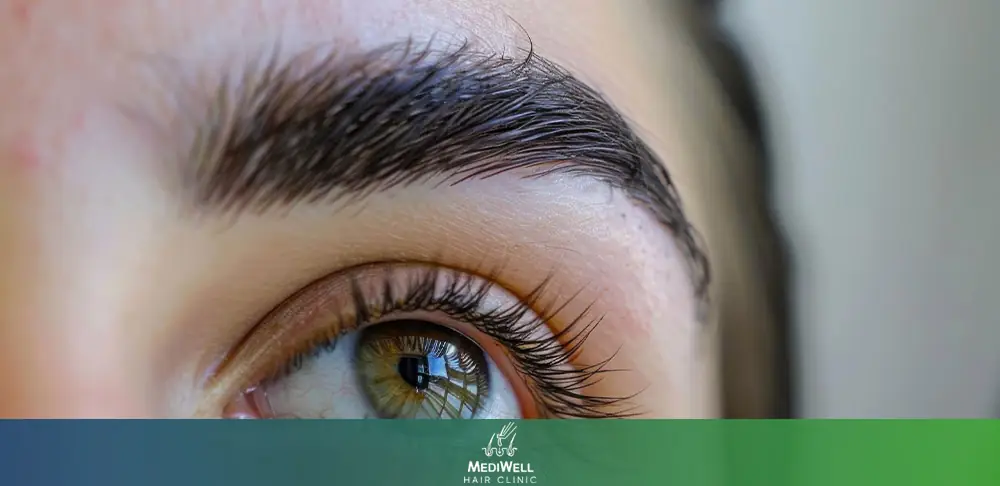
Are Eyebrow Transplant Results Permanent?
An eyebrow transplant can provide long-term and potentially lifelong results because the procedure transfers living hair follicles rather than temporarily adding pigment or artificial fibres. However, individual longevity varies, and transplanted hairs may require ongoing trimming because scalp donor hair can retain its original growth characteristics.
This distinction is particularly important when comparing an eyebrow transplant with cosmetic treatments such as microblading or eyebrow tattooing.
An eyebrow transplant creates actual hair growth.
The transplanted follicle remains biologically active after establishing itself in the eyebrow area and can continue producing hair through future growth cycles.
Clinical research supports the potential for durable eyebrow restoration. In a case series involving 352 patients, 320 patients (91%) achieved satisfactory growth, direction and appearance during follow-up extending to four years.
However, clinical outcomes vary between patients, so long-term results should never be presented as an unconditional guarantee.
What Happens to Eyebrow Transplant Results Over Time?
Eyebrow transplant results do not appear fully formed immediately after surgery. The process develops gradually through several stages.

Stage 1: The Initial Healing Period
During the first days and weeks, the transplanted follicles begin establishing themselves in the recipient area. Temporary redness, swelling, crusting and other short-term changes can occur during healing. The transplanted hairs may also look more prominent initially than they will later. This early appearance should not be considered the final result.
Stage 2: Temporary Shedding
It is normal for transplanted eyebrow hairs to shed after the procedure. This can be confusing because the visible hair may disappear even though the follicle remains present beneath the skin.
This temporary shedding is part of the normal hair-transplant growth cycle and does not necessarily indicate treatment failure. After shedding, the follicle can enter a new growth phase before producing a new hair.
Patients should therefore avoid judging the success of their eyebrow transplant based solely on the appearance of the first few weeks or months.
Stage 3: New Growth
New eyebrow hair generally becomes noticeable over the following months rather than immediately after surgery. The exact timing varies between patients.
Some patients begin seeing early new growth within several months, while further development continues progressively. This is why patience is important during eyebrow transplant recovery. The follicle needs time to establish a new growth cycle in its transplanted location.
Stage 4: Maturation
The eyebrows continue to mature as the transplanted hairs become established.
During this period, patients can begin assessing:
- density,
- direction,
- symmetry,
- hair texture,
- overall shape,
- and integration with existing eyebrow hair.
The final appearance should be evaluated only after sufficient time has passed for the transplanted follicles to mature.
Why Can Eyebrow Transplant Results Last So Long?
The longevity of an eyebrow transplant is primarily related to the survival and continued activity of the transplanted follicle.
Unlike microblading, which places pigment into the skin, an eyebrow transplant transfers an actual hair follicle from one area of the body to another. Once the follicle successfully establishes itself in the eyebrow area, it can continue producing hair.
However, there is an important consideration:
Transplanted scalp hair remains scalp hair.
The donor follicles commonly used for eyebrow transplantation come from areas such as the scalp or around the ear. After transplantation, these follicles can retain some of their original biological characteristics.
This means the transplanted hair may continue growing longer and faster than natural eyebrow hair. As a result, patients may need to trim the transplanted hairs periodically to maintain an eyebrow-appropriate length.
This does not mean that the transplant has failed. It is a normal characteristic of using real hair follicles for eyebrow restoration.
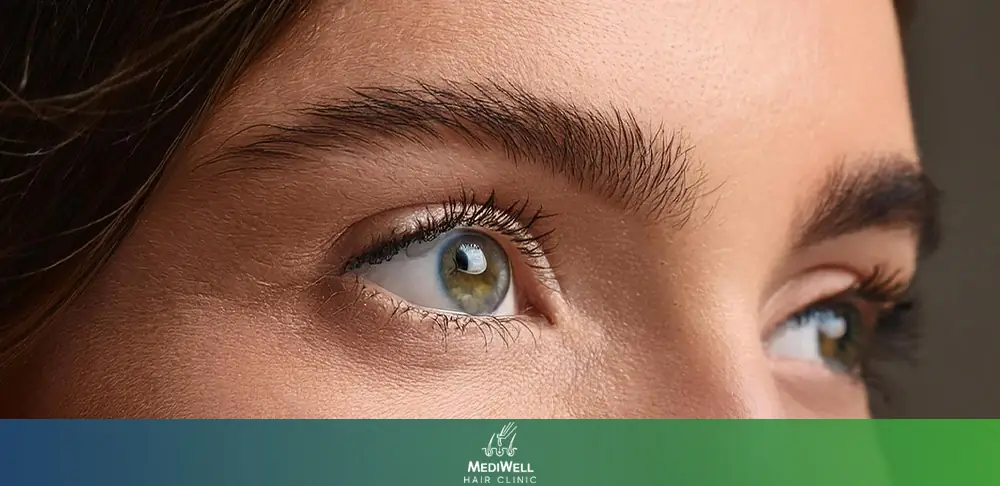
Do Eyebrow Transplant Hairs Keep Growing Forever?
Transplanted follicles can continue producing hair for a very long time and potentially for life in suitable patients, but an exact lifespan cannot be guaranteed for every individual.
A more accurate way to understand an eyebrow transplant is:
The procedure creates long-term biological hair growth rather than a temporary cosmetic effect.
The longevity of the transplanted hair depends on the individual follicle, donor area, recipient environment and underlying cause of eyebrow loss.
This is why a thorough assessment before treatment is important.
For example, a patient whose eyebrows became permanently sparse after years of overplucking may have a different long-term outlook from someone whose eyebrow loss is caused by an active inflammatory or autoimmune condition.
What Can Affect the Longevity of Eyebrow Transplant Results?
Several factors can influence how successful and durable an eyebrow transplant result is.
1. The Cause of Eyebrow Hair Loss
This is one of the most important considerations.
If eyebrow loss resulted from:
- overplucking,
- trauma,
- burns,
- scarring,
- naturally sparse eyebrows,
- or stable cosmetic-related hair loss,
an eyebrow transplant may provide a long-term restoration option when the recipient area and donor supply are suitable.
However, ongoing inflammatory or autoimmune hair-loss disorders require greater caution.
One important example is frontal fibrosing alopecia (FFA), which can cause eyebrow loss and continue to affect hair follicles.
In a study of 10 patients with FFA who underwent eyebrow transplantation, 80% achieved excellent hair growth at 6–12 months, but the majority subsequently began losing transplanted hairs after 3–4 years.
This is why “permanent” should never be presented as an unconditional guarantee.
The underlying cause of hair loss should always be considered before discussing long-term expectations.
2. Donor Hair Quality
The characteristics of the donor follicles matter.
Hair thickness, texture, growth pattern and the suitability of the donor area can all influence the final appearance.
For eyebrow restoration, the objective is not simply to maximise the number of grafts.
It is to select appropriate follicles and place them carefully to create:
- natural density,
- appropriate direction,
- suitable spacing,
- balanced symmetry,
- and a facially natural eyebrow shape.
The donor area should therefore be assessed individually rather than treating every patient according to the same graft-selection strategy.
3. Graft Placement and Hair Direction
Hair direction is one of the most important factors in achieving a natural-looking eyebrow transplant.
Eyebrow hairs lie relatively flat against the skin and change direction across different sections of the brow.
If transplanted follicles are inserted at an inappropriate angle or direction, the result may look unnatural even when the grafts survive successfully.
Clinical research involving patients dissatisfied with previous eyebrow transplantation has identified problems such as irregular density, disordered growth direction, inappropriate graft selection and inadequate understanding of natural eyebrow anatomy among factors associated with poor aesthetic outcomes.
This demonstrates an important point:
Long-lasting hair growth is only one part of a successful eyebrow transplant. The hair must also grow in a direction and pattern that works naturally with the eyebrow.
Does an Eyebrow Transplant Get Better With Time?
In many cases, the result becomes more natural as the transplanted hairs mature.
The early postoperative appearance should not be considered the final result.
Over time:
- transplanted hairs shed,
- follicles enter a new growth cycle,
- new hairs emerge,
- density gradually develops,
- the eyebrows mature,
- and the transplanted hairs can be groomed and trimmed into the desired shape.
Some patients may require additional density or refinement depending on their starting point and desired result.
A clinical series of 352 eyebrow-transplant patients followed for up to four years reported satisfactory growth, direction and appearance in 91% of patients.
Therefore, an eyebrow transplant should be assessed as a long-term restoration process, rather than judged by the first few weeks after surgery.
An eyebrow transplant can provide long-lasting eyebrow hair growth, potentially for many years or a lifetime in suitable patients. However, transplanted scalp hairs may require regular trimming, and long-term results can be affected by the cause of eyebrow loss, donor-hair characteristics, follicle survival, hair direction and surgical planning.
For this reason, the most important question is not simply:
“Will my eyebrow transplant last?”
It is:
“Am I a suitable candidate, and can the transplanted follicles be used to create a natural and sustainable eyebrow?”
How Long Can Eyebrow Transplant Results Last: 1, 5 and 10+ Years?
One of the most common questions patients ask is whether their eyebrow transplant will still look good many years after surgery.
There is no scientifically accurate way to promise an identical result for every patient at 5, 10 or 20 years.
However, eyebrow transplantation is considered a long-term hair restoration procedure because viable follicles are transferred into the eyebrow rather than temporarily adding pigment or artificial hair.
For suitable patients, transplanted follicles can continue producing hair for many years and potentially for life.
The important distinction is that long-lasting does not mean maintenance-free.
Patients may continue to require:
- regular trimming,
- occasional shaping,
- monitoring of density and symmetry,
- and professional follow-up when appropriate.
The appearance can also evolve as transplanted hairs mature and as the patient’s natural eyebrows change over time.
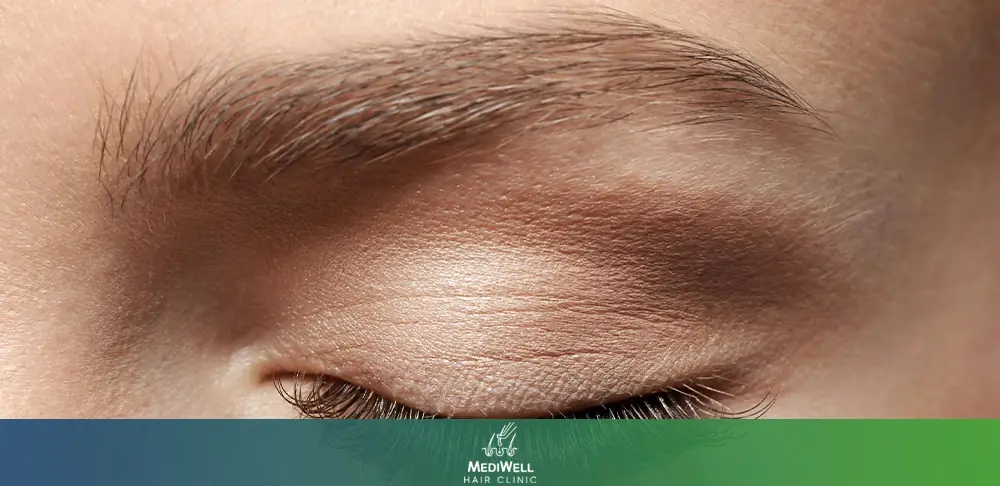
What Should You Expect From an Eyebrow Transplant After 1 Year?
By approximately one year, much of the visible growth and maturation from an eyebrow transplant should have developed, although individual timelines vary.
At this stage, patients can generally assess:
- hair growth,
- density,
- symmetry,
- hair direction,
- texture,
- integration with existing eyebrow hair,
- and overall eyebrow shape.
The transplanted hairs may still behave differently from native eyebrow hairs because donor hairs commonly originate from the scalp.
A four-year follow-up study involving 352 patients found that 320 patients, or 91%, achieved satisfactory growth, direction and appearance after single-follicular-unit eyebrow transplantation.
This provides useful evidence that eyebrow transplantation can produce durable results, but it should not be interpreted as a guarantee of identical results for every individual.
What Happens to Eyebrow Transplant Results After 5 or 10 Years?
For a suitable patient with a stable cause of eyebrow hair loss, the transplanted follicles may continue producing hair many years after surgery.
However, the appearance of the eyebrows can change even when the transplanted follicles remain healthy.
This can happen because:
- facial features change with age,
- native eyebrow hairs may become thinner,
- transplanted hairs may require continued trimming,
- the patient’s preferred eyebrow shape may change,
- surrounding hair density may change,
- or additional hair loss may occur because of an underlying condition.
Therefore, longevity should be considered in two separate ways:
Biological Longevity
How long the transplanted follicles continue producing hair.
Aesthetic Longevity
How long the overall eyebrow appearance remains satisfactory without requiring refinement. These are not necessarily the same thing. A patient may have long-lasting transplanted hair but still choose cosmetic refinement years later.
Why Do Transplanted Eyebrow Hairs Need Trimming?
This is one of the most important things to understand before choosing an eyebrow transplant.
The transplanted hair does not automatically become genetically identical to a native eyebrow hair simply because it has been moved to the eyebrow.
When scalp hair is used as the donor source, the transplanted hairs can retain some of their original growth characteristics.
Consequently, transplanted hairs may grow longer than natural eyebrow hairs.
Regular trimming can therefore be necessary to maintain:
- the desired eyebrow length,
- a clean appearance,
- the intended eyebrow shape,
- and symmetry between the two brows.
This maintenance requirement does not mean that the transplant has failed.
It is simply one of the long-term characteristics of using real hair follicles for eyebrow restoration.
Can Eyebrow Transplant Results Become Less Natural Over Time?
They can, particularly if the original surgical planning was inadequate. An eyebrow transplant is not simply about placing hair into an empty area.
The treatment needs to account for the natural anatomy of the eyebrow, including:
- direction of growth,
- angle of emergence,
- density,
- single-hair graft selection,
- medial and lateral brow characteristics,
- transition between transplanted and existing hairs,
- and facial proportions.
Clinical research examining dissatisfied eyebrow-transplant patients has identified irregular density and disordered growth direction among common problems.
This reinforces an important principle:
A long-lasting eyebrow transplant is not automatically a natural-looking eyebrow transplant.
Both follicle survival and aesthetic planning matter.
Can the Cause of Eyebrow Hair Loss Affect Long-Term Results?
Yes. The cause of eyebrow hair loss is one of the most important factors when considering the longevity of an eyebrow transplant.
A patient whose eyebrows became permanently sparse after years of overplucking may have a different long-term outlook from someone whose eyebrow loss is caused by an active inflammatory or autoimmune disorder.
For example, frontal fibrosing alopecia (FFA) can cause eyebrow loss and may continue to affect transplanted follicles.
In a study involving 10 patients with FFA, 80% initially achieved excellent growth at 6–12 months. However, the majority subsequently experienced loss of transplanted hairs after 3–4 years.
A systematic review of hair transplantation in FFA and lichen planopilaris also concluded that outcomes may be less favourable than transplantation for other causes of hair loss and that the available evidence remains limited.
For this reason, a responsible eyebrow transplant consultation should establish why the eyebrow hair has been lost before discussing permanence.
If there is an active or progressive hair-loss condition, appropriate medical assessment may be necessary before surgery.
Can an Eyebrow Transplant Be Maintained Without Another Surgery?
In many suitable patients, yes.
The purpose of a successful eyebrow transplant is to create a stable source of natural hair growth rather than requiring repeated pigment treatments.
However, patients may need ongoing grooming.
Regular Trimming
Because transplanted scalp hairs can grow longer than native eyebrow hairs.
Occasional Shaping
The patient may need to maintain the intended eyebrow contour.
Monitoring
Changes in native eyebrow density or an underlying hair-loss condition should be assessed if they occur.
Additional Treatment When Necessary
Some patients may eventually consider refinement or additional grafts if density, symmetry or their aesthetic preferences change.
A second procedure should not automatically be interpreted as failure.
Facial hair patterns and aesthetic preferences can change over time.
Eyebrow Transplant vs Microblading: Which Lasts Longer?
An eyebrow transplant and microblading work in fundamentally different ways.
| Feature | Eyebrow Transplant | Microblading |
|---|---|---|
| What is added? | Living hair follicles | Pigment |
| Does actual hair grow? | Yes | No |
| Long-term nature | Potentially lifelong | Semi-permanent |
| Maintenance | Trimming may be required | Pigment refresh may be required |
| Hair texture | Real hair | Pigment strokes |
| Suitable for | Suitable candidates with eyebrow hair loss or sparsity | Cosmetic enhancement |
Microblading can create the visual impression of individual eyebrow hairs, but it does not restore biological hair growth. An eyebrow transplant, by contrast, transfers follicles capable of producing actual hair.
The appropriate option therefore depends on the patient’s objective. If the primary goal is actual hair restoration, an eyebrow transplant may be considered.
If the goal is semi-permanent cosmetic enhancement without surgery, pigmentation techniques may be more appropriate.
What Makes an Eyebrow Transplant Last Longer?
There is no single factor that guarantees longevity. Instead, the outcome depends on several parts of the treatment process.
- Correct Patient Selection
The cause of eyebrow loss should be understood before surgery.
- Appropriate Donor Follicles
The donor hair should be selected according to the patient’s anatomy and the desired aesthetic result.
- Precise Graft Placement
Single-hair follicular units and appropriate placement can help produce a more natural appearance.
- Correct Growth Direction
Eyebrow hairs do not all grow in exactly the same direction.
Their orientation changes across different sections of the brow.
- Proper Postoperative Care
Patients should follow their clinic’s aftercare instructions carefully during the healing period.
- Understanding Long-Term Maintenance
Patients should understand that transplanted hairs may require trimming even when the follicles remain healthy.
Can an Eyebrow Transplant Fail Years Later?
A loss of transplanted hair years after surgery is possible, but it should not be assumed that every eyebrow transplant will eventually fail.
The underlying cause of eyebrow loss is particularly important.
Stable, non-progressive causes of eyebrow loss can have a different prognosis from active inflammatory or autoimmune conditions.
For this reason, a responsible clinic should avoid guaranteeing that every patient will retain exactly the same density for life.
A more accurate statement is:
An eyebrow transplant can provide long-term, potentially lifelong hair growth in appropriately selected patients, but individual outcomes depend on the underlying cause of hair loss, follicle survival, surgical technique and long-term changes.
That distinction is important for informed decision-making.
Frequently Asked Questions
Is an eyebrow transplant permanent?
An eyebrow transplant is considered a long-term and potentially permanent hair-restoration procedure because living hair follicles are transplanted into the eyebrow. However, individual results vary, and the transplanted hairs may require ongoing trimming.
How many years does an eyebrow transplant last?
For suitable patients, transplanted eyebrow follicles can continue producing hair for many years and potentially for life. The longevity of the overall aesthetic result can vary depending on the cause of eyebrow loss, donor hair and surgical factors.
Do eyebrow transplants need maintenance?
Yes. The transplanted hairs may require regular trimming because donor hairs commonly come from the scalp and can continue growing longer than natural eyebrow hairs.
Do eyebrow transplant hairs fall out permanently?
The transplanted hairs commonly shed during the early postoperative period before new growth develops. This temporary shedding is part of the normal hair-transplant process. Long-term loss of transplanted hairs can occur in some patients, particularly when the underlying cause of hair loss remains active.
Can an eyebrow transplant last 10 years?
Yes. In suitable candidates, transplanted follicles can continue producing hair for 10 years or longer. However, the appearance of the eyebrows may change over time because of ageing, native eyebrow changes or the underlying cause of hair loss.
Will eyebrow transplant hairs grow like normal eyebrow hair?
Not necessarily. When scalp hair is used, the transplanted hairs can retain scalp-like growth characteristics and may grow longer. Regular trimming can help maintain an eyebrow-appropriate appearance.
Is eyebrow transplant better than microblading?
They provide different types of results. An eyebrow transplant restores actual hair growth, while microblading creates a semi-permanent pigment effect. The appropriate option depends on whether the patient’s priority is biological hair restoration or cosmetic enhancement.
Can eyebrow transplant results be lost?
Yes, although long-term survival can be excellent in suitable patients. Progressive hair-loss disorders, particularly some inflammatory conditions, can make long-term results less predictable.
According to a systematic review published in the medical literature, eyebrow hair transplantation can provide long-term hair restoration, although outcomes may vary depending on the underlying cause of eyebrow hair loss, the transplantation technique and individual patient factors.
Table of Contents
Book a Consultation
Simply fill in your details and we’ll get in touch with you shortly.

Location Of Our Hair Transplant Clinic
Contact our hair transplant clinic, located in the heart of London, now.
- 02039 510 203
- 07947 322 737
- 1C Lansdowne Rd, N17 0LL, London